
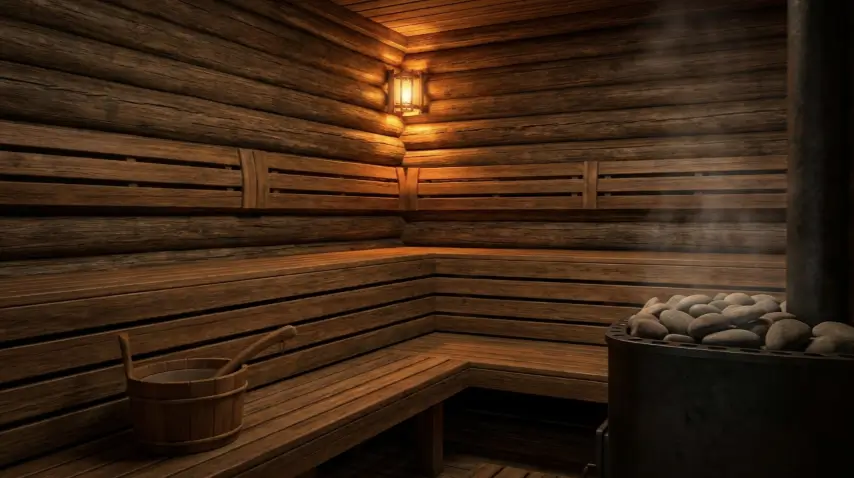
How to Maintain a Traditional Sauna So It Lasts for Years

Routine upkeep on a kiln-dried traditional sauna runs about $75 to $200 a year in supplies, rock replacement, and the occasional seal swap, spread across ten minutes a week and a couple of longer seasonal checks. Owners who skip that routine for two or three years commonly face $1,000 to $3,000 in panel, bench, or stove repairs once trapped moisture reaches the wood framing behind the paneling. The gap between those two numbers comes down to a short list of habits, not a major time commitment.
What Does the Cabin Need After Every Session?
Wipe down the upper and lower benches with a soft cloth or a mild, pH-neutral wood cleaner, then prop the door open until the tongue-and-groove paneling has fully dried. Spruce and cedar interiors hold moisture in their grain, and a cabin that never gets a chance to dry between sessions is the most common starting point for the graying, staining, and eventual softening of wood that leads to expensive repairs. This step takes well under five minutes and matters more than almost anything else on this list.
How Often Should the Stove and Stones Be Inspected?
Check the sauna stones monthly for a chalky white crust, cracking, or crumbling at the edges, all signs that heat transfer is degrading and the stove is working harder than it should to hold temperature. On an electric heater, look at the element housing for scale buildup if local water is hard; on a wood-burning stove, clear ash from the firebox and check the flue for creosote before each heavy-use season. None of this takes more than fifteen minutes, but it is often the difference between a stove that lasts a decade and one that needs early replacement.
What Belongs on a Seasonal Checklist for Wood Paneling?
Twice a year, inspect the door seal and hinge alignment, since a seal that no longer closes evenly lets heat escape and forces the stove to run longer for the same result. Vacuum dust from around the heater guard and vents, and on any exterior-facing wall, look for gaps in the sealant where kiln-dried wood has shrunk or swelled with the seasons. A fresh coat of exterior sealant every one to three years, depending on sun and rain exposure, keeps the outer shell from graying and checking prematurely.
Which Cleaning Products Are Actually Safe on Cedar and Spruce?
Stick to a soft-bristle brush, a damp cloth, and a wood-safe cleaner without bleach, ammonia, or strong solvents, all of which strip the natural oils that make cedar and heat-treated spruce resistant to moisture in the first place. Skip the pressure washer entirely, indoors or out, since forcing water into the tongue-and-groove joints does more damage than the dirt it removes and can drive moisture into the vapor barrier behind the panels. A full year of the right supplies for a typical two- to four-person cabin costs well under $100.
How Should the Ventilation System Be Maintained?
A traditional cabin depends on a low intake vent near the stove and a higher exhaust vent on the opposite wall to keep fresh air moving through the room, and blocked or painted-over vents are a common reason a sauna starts to feel stuffy or takes longer to reach a comfortable temperature. Twice a year, vacuum both vents and check that nothing, towels, spare wood, or stored stones, has been left in front of either opening. If the cabin has a window or a small vented panel in the door, wipe the gasket and confirm it still seals evenly, since a warped gasket lets conditioned heat escape the same way a bad door seal does. Good airflow also matters for wood longevity: stale, humid air trapped in the cabin between sessions is what encourages the mold and graying that a quick wipe-down and open door are meant to prevent in the first place.
See also: Peptides After 40: I Read the Actual Studies So You Don’t Have to Trust a Guy in a Tank Top
What Tools and Supplies Are Worth Keeping on Hand?
A small maintenance kit covers almost everything a traditional cabin needs: a soft-bristle brush, a wood-safe cleaner, a spare door gasket, a bucket and ladle dedicated to the sauna, and one or two backup sauna stones in case one cracks mid-season. Keeping a spare heating element on hand is optional for most owners, since replacement is infrequent, but it is worth knowing the exact model number before a stove ever fails so a repair does not turn into a multi-week wait for the right part. Storing all of this in a small bin near the cabin, rather than scattered in a garage, makes the ten-minute weekly routine much more likely to actually happen.
What Parts Wear Out First, and When Should They Be Replaced?
Sauna stones take the most punishment and typically need replacing every one to two years under regular use, sooner if they crack from repeated water contact on a hot surface. Door seals usually last two to four years before compression sets in, and heating elements or stove components generally outlast both when the stove is not overworked by degraded stones or a leaking seal. Anyone weighing replacement parts against the cost of a new cabin can check current sizes and pricing through SweatDecks alongside other specialty retailers before deciding whether repair still makes sense.
What Does Skipping Maintenance Actually Cost?
A cabin that goes two or three years without wipe-downs and seasonal checks tends to develop a predictable pattern: moisture staining near the floor boards, benches that feel soft or spongy underfoot, and a stove working overtime because of scaled elements or degraded stones. Replacing warped lower panels alone commonly runs $400 to $900 depending on cabin size and wood species, and a stove replaced early due to accumulated mineral damage adds another $700 to $2,000. Almost none of that is necessary on a cabin that gets the basic routine above.
Does Upkeep Affect the Health Associations Researchers Report?
A stove that reliably reaches and holds its rated temperature is what actually supports the kind of regular sauna use tied to the cardiovascular associations researchers have measured in long-running Finnish cohorts. Data published in JAMA Internal Medicine linked frequent sauna sessions with lower rates of fatal cardiovascular events, and a cohort study in Annals of Medicine reported similar associations tied to consistency of use over years, not a single session. A cabin that heats unevenly or takes twice as long to reach temperature works against exactly the kind of routine those studies describe.
Frequently Asked Questions
How often should sauna stones be replaced in a traditional cabin? Every one to two years under regular use, sooner if the stones crack, crumble, or develop a chalky white surface that signals reduced heat transfer.
Does a traditional sauna need to be cleaned after every use? A quick wipe-down of the benches plus leaving the door open to dry the paneling takes under five minutes and is the most effective habit for preventing wood staining and mold.
How much does skipping maintenance typically cost over a few years? Neglect for two to three years commonly leads to $1,000 to $3,000 in panel, bench, or stove repairs, compared with roughly $75 to $200 a year in routine supplies.
How often should the door seal be checked? At least twice a year, usually at the start and end of the season with the heaviest use, since a worn seal lets heat escape and makes the stove run longer.
References
- Association between sauna bathing and fatal cardiovascular and all-cause mortality events, JAMA Internal Medicine, 2015
- Joint associations of sauna bathing and cardiorespiratory fitness on cardiovascular and all-cause mortality risk: a long-term prospective cohort study, Annals of Medicine, 2018
- Short-term effects of Finnish sauna bathing on blood-based markers of cardiovascular function in non-naive sauna users, Heart and Vessels, 2018
By Marcus Whitfield